14 November 2026
More sole trader guidesAll writingAllowable expenses for self-employed mechanics: a UK guide
What a self-employed mechanic can usually claim, from tools and parts to overalls, workshop costs and mobile callouts, and the parts worth checking before you file.
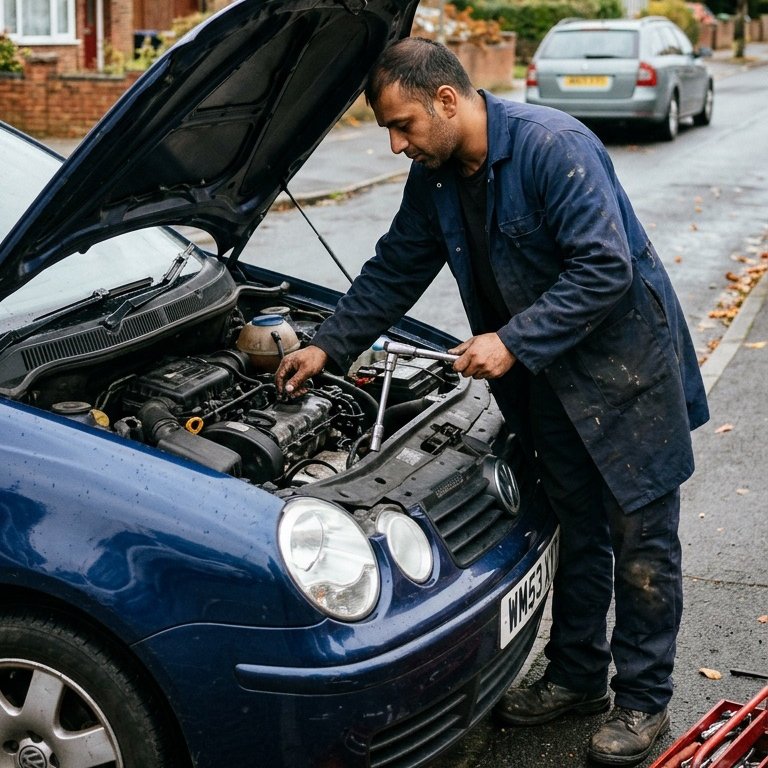
If you fix cars from your own unit, travel to customers in a van, or work on a driveway or from a garage at home, and nobody runs payroll for you, you’re probably self-employed. That means you report your income through Self Assessment and can take allowable expenses off it before tax is worked out. A mechanic’s costs run from big one-off tools to a steady stream of small parts and consumables, often bought in the same trade counter visit as something for your own car. This guide goes through what mechanics can usually claim, the rules behind each item, and the areas worth checking first.
It goes into more detail than our general sole trader expense checklist, and it follows the same approach as the cleaners guide and the hairdressers and barbers guide. It’s general information, not tax advice. Where GOV.UK or HMRC’s manual doesn’t cover something, the guide says so and falls back on the general test, so treat those points as things to confirm with HMRC rather than settled answers.
First, check you’re self-employed
If you take bookings from your own customers, set your own prices and use your own tools, you’re likely a sole trader. If a garage sets your hours, supplies the work and pays you a set rate, you may be employed, and the rest of this guide won’t apply in the same way. GOV.UK has an employment status page to start with.
The test behind every claim
A cost is allowable if you spend it wholly and exclusively for the business. If something has a clear business part you can identify, you can claim that part (BIM37007). Anything you also use at home or on your own car only counts for the business share.
If your costs are small, you could use the £1,000 trading allowance instead, but then you can’t claim expenses as well (Expenses if you’re self-employed). A mechanic doing a few jobs on the side might be better off with the allowance. Someone working full time will almost certainly have more than £1,000 in real costs.
Tools and equipment
Spanners and socket sets, torque wrenches, jacks, axle stands, ramps, compressors, diagnostic scanners, battery chargers and similar kit are equipment you keep for the business. How you claim them depends on your accounting method:
- Cash basis, now the default for sole traders (business records): items you buy and keep for the business are claimed as normal allowable expenses (Expenses if you’re self-employed).
- Traditional accounting: equipment is claimed through capital allowances instead (office, property and equipment).
Repairs and maintenance of business equipment are allowable too (same page), for example servicing a compressor or replacing a worn tool. Software you use for the business, such as diagnostic or workshop management subscriptions, is allowable as well. If a tool is also used on your own car or for home jobs, only the business share counts.
Parts, oil and consumables
Parts you buy to fit on customers’ vehicles, and materials like oil, filters, brake fluid and cleaning products used up on jobs, are business costs. GOV.UK lists goods for resale and raw materials as allowable, and says goods bought for private use can’t be claimed (reselling goods).
The mixed trade counter visit is where the records usually go wrong. If you pick up pads for a customer’s car and a bulb for your own in one purchase, only the customer’s part is a business cost. Keep the invoice, mark the work lines, and don’t claim parts that went on your own vehicle.
Overalls and safety kit
GOV.UK allows protective clothing needed for the work, such as safety boots, and clothing that protects your everyday clothes, such as overalls, as long as you only use it for work (clothing expenses). Workwear with your business name on it is more likely to count as a uniform. For a mechanic I’d expect gloves and eye protection to count as protective, but GOV.UK doesn’t name them, so check if you’re unsure.
You can’t claim everyday clothing, even if it only ever gets worn in the workshop. HMRC’s manual explains why: ordinary clothes also meet the personal need to be dressed (BIM37910). Old jeans and a T-shirt stay personal, however oily they get.
Workshop, unit and home costs
If you rent a unit or workshop, the rent, business rates and utility bills are allowable, as are repairs and maintenance of the premises (office, property and equipment). Keep the lease or rent invoices and the bills.
If you work from a garage or driveway at home, you can claim for the part of your home that’s used for business, but not for any non-business use (same page). Two wider points are worth knowing before you set a space aside as a dedicated workshop. For capital gains tax, GOV.UK says you get Private Residence Relief automatically only if you haven’t used a part of your home exclusively for business, and that using a room as a temporary or occasional office doesn’t count as exclusive use (tax when you sell your home). Business rates can also become payable on a part of a home that’s used only for the business, so check with your local council if you plan a permanent, fully fitted-out workshop. A working-from-home flat rate can also be used for admin hours, if you do 25 or more hours a month (working from home).
Travel and callouts
This depends on how you work.
- Based at a unit or garage: going from home to that same place each day is commuting, and you can’t claim it (travel; BIM37605).
- Mobile mechanic: if you travel from home to different customers’ addresses and your home is your base, HMRC’s manual treats the travel between home and each job as allowable (BIM37620). Travel between jobs during the day is a business journey either way. Keeping tools at home doesn’t automatically make your home the base (BIM37635).
If you do a mix of both, talk it through with an accountant with your diary to hand.
Vans, cars and mileage
You can claim the business share of your actual vehicle running costs, which GOV.UK lists as fuel, insurance, repairs and servicing, breakdown cover and vehicle tax (travel). Or you can use a flat rate per business mile under simplified expenses (vehicles):
- Cars and vans: 45p a mile for the first 10,000 miles before 6 April 2026, and 55p in the 2026 to 2027 tax year. After 10,000 miles it’s 25p in both.
- Motorcycles: 24p a mile.
The return due on 31 January 2027 covers 2025 to 2026, so use 45p for that one. Once you use the flat rate for a vehicle you have to keep using it while you use that vehicle in the business, and you can’t use it for a vehicle you’ve already claimed capital allowances on or whose costs you’ve already included as an expense (same page). If you use a van mainly for work, the flat rate may or may not beat actual costs, and GOV.UK has a simplified expenses checker to compare them. Parking for business journeys goes on top, but parking fines and penalty charges can’t be claimed (travel).
If you’re buying the vehicle itself, your accounting method matters. GOV.UK says that under cash basis you claim capital allowances on a car, while other business items you buy and keep are claimed as normal expenses, and that under traditional accounting you claim capital allowances on vehicles such as cars and vans (Expenses if you’re self-employed). Check which applies to your accounts before you buy. A vehicle you’ve claimed capital allowances on can’t also use the flat mileage rate.
Whichever method you use, keep a mileage log with the date, customer and miles.
Waste oil, batteries and other waste
Garage work produces waste that has its own rules. If your business collects and transports hazardous waste in England, one of the first steps is to register as a waste carrier (carriers of hazardous waste; register as a waste carrier, broker or dealer). Those GOV.UK pages don’t name used oil or vehicle batteries, so I can’t tell you whether a particular item counts as hazardous waste for you. If you take waste like that away from jobs, check the Environment Agency’s hazardous waste guidance first. GOV.UK says registration is usually free if you only carry waste you produce yourself, and warns of an unlimited fine if you don’t register (register as a waste carrier, broker or dealer). The rules differ between the UK nations.
For tax, GOV.UK doesn’t list waste disposal or registration fees by name, so apply the usual test. Charges you pay because the business produces the waste are generally business costs. Keep the receipts and waste transfer paperwork, and ask an accountant if you’re unsure how a specific charge should be treated.
Insurance, training and the admin side
- Insurance for the business, such as public liability, is allowable (legal and financial costs). Specialist garage or motor trade cover is a business insurance policy, so it falls under the same rule.
- Training that updates skills you already use in the business, such as a refresher on a newer vehicle technology, is allowable. Training for a new, unrelated business isn’t (training courses).
- Subscriptions: GOV.UK lists trade or professional journals among allowable subscriptions (Expenses if you’re self-employed). For trade association memberships, GOV.UK’s pages don’t say more, but HMRC’s manual lets you deduct the part of a trade association subscription that the association spends on things you could have deducted yourself (BIM47420). Subscriptions are otherwise tested against the wholly-and-exclusively rule (BIM37500).
- Bank charges and accountancy fees for business reasons are allowable, but not the cost of preparing and submitting your Self Assessment return itself (legal and financial costs). Fines for breaking the law can’t be claimed (same page).
- Phone and software: claim the business share of your phone and any booking or invoicing app (office, property and equipment).
- Advertising, such as a website, a directory listing or flyers, is allowable (marketing, entertainment and subscriptions).
What usually isn’t allowable
- everyday clothes and shoes, even if only worn in the workshop (clothing)
- travel from home to a unit or garage you work at every day (BIM37605)
- parts and tools bought for your own vehicle (reselling goods)
- parking fines, penalty charges and other fines (travel; legal and financial costs)
- the personal share of anything you also use at home
Records to keep
You don’t send receipts with your return, but you need to be able to back up what you claim. Keep receipts, invoices, bank statements and a mileage log (what records to keep), for at least 5 years after the 31 January deadline for that tax year (how long to keep your records).
A short list to copy:
- Keep supplier invoices for parts, and mark which lines went on customer jobs.
- Photograph receipts for small items and tools the day you buy them.
- Log mileage per job, with the customer and the miles.
- Write down how you split your phone, van, tools and any home workshop space between work and personal use, and use the same method next year.
Where Tidysum fits
Most of the receipts here are small and frequent, like a set of filters, a can of oil or a trade counter bill. Tidysum is built for keeping track of those. You photograph a receipt when you get it, it suggests a category and explains why, and you confirm it. At the end of the year you can export a categorised record for your accountant or your own return. It doesn’t file anything or decide what’s allowable for you.
For the deadline itself, see what to have ready before the 31 January Self Assessment deadline.
Tidysum suggests categories, but you (or your accountant) decide what's allowable.